
Case study · Our product
One storefront engine for three different retail catalogs
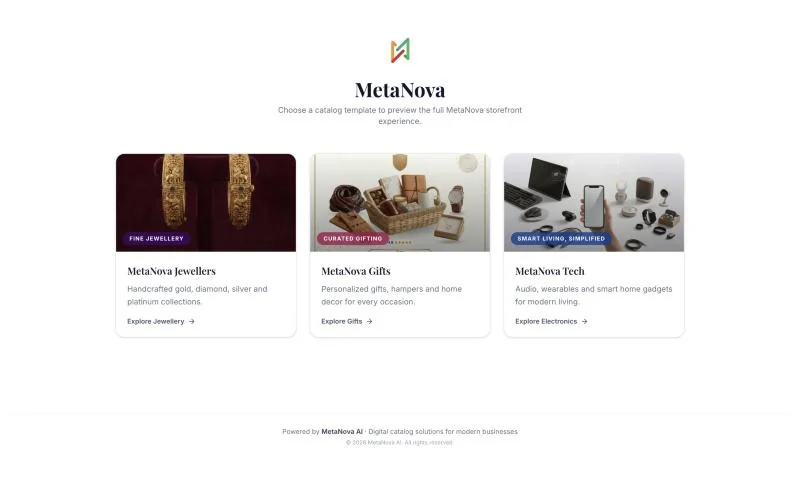
A single digital catalog platform that powers a fine jewellery storefront, a curated gifting storefront and an electronics storefront from one engine, with live gold, silver, platinum and diamond rates driving jewellery pricing in real time.
At a glance
The project in brief
- Business: digital catalog and storefront product for retail businesses, built and run by MetaNova AI
- What we built: one storefront engine with three selectable templates, fine jewellery, curated gifting and electronics, sharing the same account, cart and order flow
- Scope: catalog browsing, cart and orders, live metal-rate pricing for jewellery, multi-template theming
- Team: MetaNova AI delivery and engineering from Hyderabad
The challenge
The same storefront, needed in very different categories
Small and mid-sized retailers in very different categories, jewellery, gifting, electronics, all need the same basic storefront: browse a catalog, add to cart, place an order. Building that storefront from scratch for each one is the kind of work that is worth doing once, properly, and reusing.
Jewellery retail adds a wrinkle the other categories do not have: the price of a piece is not fixed, it moves with the daily gold, silver, platinum and diamond rate. A catalog that quotes yesterday's price is quoting the wrong price, and recalculating every product by hand every day is not something a small retailer can sustain.
The goal was one engine that could be relaunched under a new name and catalog for a new client in days, not months, while still handling the one category, jewellery, that needs its pricing to move with the market in real time.
What we set out to do
Four goals we agreed before writing code
- Build one storefront engine, not three separate ones, so new verticals are a template away
- Give jewellery retailers pricing that reflects the live metal rate, not a static price
- Keep account, cart and order flow identical across templates so the engine stays one codebase
- Make switching a retailer's branding and catalog content a configuration change, not a rebuild
How we approached it
One engine, proven across three real templates
Separate the storefront engine from the catalog content
Account, cart, checkout and order history are the same regardless of what is being sold. We built those once, and kept every category-specific decision, branding, categories, pricing rules, out of that core.
Build jewellery pricing on a live rate, not a stored price
A jewellery product stores its metal, karat and weight. Its price is calculated at the moment it is shown, from the current rate, not looked up from a number set when the product was added.
Prove the model with three genuinely different templates
Rather than build one template and assume it would generalise, we built fine jewellery, curated gifting and electronics side by side, so the engine's limits showed up early, while they were still cheap to fix.
Make a new template a configuration, not a fork
Branding, category structure and catalog content are data, not code. Standing up a new retailer under the same engine means populating that data, not writing a new storefront.
What we built
One engine, three storefronts
A shared storefront engine
Account creation and sign-in, category browsing, cart and order history work identically across every template, built once and reused rather than rebuilt per vertical.
Three live templates on one engine
Fine jewellery, curated gifting and electronics each get their own branding, categories and catalog, while sharing the same underlying platform and the same account a shopper already has.
Live metal-rate pricing for jewellery
Gold, in 24K and 22K, silver, platinum and diamond rates are shown as a live ticker and used directly in pricing, so a product's price reflects the metal market at the moment a shopper looks at it, not the day it was catalogued.
Weight and purity-aware product pricing
Each jewellery product carries its metal weight and purity, for example 18Kt white gold at 3.8 grams, and its displayed price is computed from that specification against the live rate, rather than stored as a flat number that goes stale.
Category browsing by material and type
Shoppers filter by category, diamond, gold, silver or platinum jewellery in the jewellery template, audio, wearables and smart home in the electronics template, using the same underlying browsing component with different data.
Design decisions
The choices that made it work
One engine, many templates, instead of one app per client
The cost of a shared platform is discipline: nothing category-specific is allowed to leak into the core. The payoff is that a new retailer in a new category is a content and branding exercise, not a new build.
Price calculated at view time, not stored at catalog time
Storing a jewellery product's price would make it wrong the next day. Calculating it from weight, purity and the live rate every time it is shown is what keeps it accurate without anyone touching the catalog.
A visible rate ticker, not a hidden pricing rule
Showing the live gold, silver, platinum and diamond rates on the page, rather than only using them invisibly in a price calculation, makes the pricing legible and trustworthy to the shopper looking at it.
Three real templates before calling the engine done
A single template proves nothing about reusability. Building three genuinely different ones before calling the platform finished is what actually tested whether the separation between engine and content held.
Under the hood
How it is built
- Next.js and React with TypeScript
- A shared account, cart and order data model reused across every template
- A live metal-rate feed driving jewellery product pricing at render time
- Per-template theming and catalog content stored as configuration, not code
- Category and product browsing components shared across verticals
The result
What changed
- One engine runs three different retail storefronts today
- Jewellery prices always reflect the current metal rate, with no manual repricing
- A new retailer under an existing category is a content and branding change, not a new build
- Shoppers get one consistent account, cart and ordering experience across every template
What comes next
Where this goes next
- Inventory sync so a retailer's stock levels drive what the catalog can sell
- A fourth template for a category with its own pricing logic, such as made-to-order goods
- Payment integration per retailer's own payment provider